Marine Corps News
No US casualties reported following Iran’s retaliatory strikes, officials say
CENTCOM officials also claimed that "damage to U.S. installations was minimal and has not impacted operations."
A barrage of Iranian retaliatory strikes on U.S. military installations across the Middle East on Saturday resulted in no casualties to American personnel, U.S. Central command officials said.
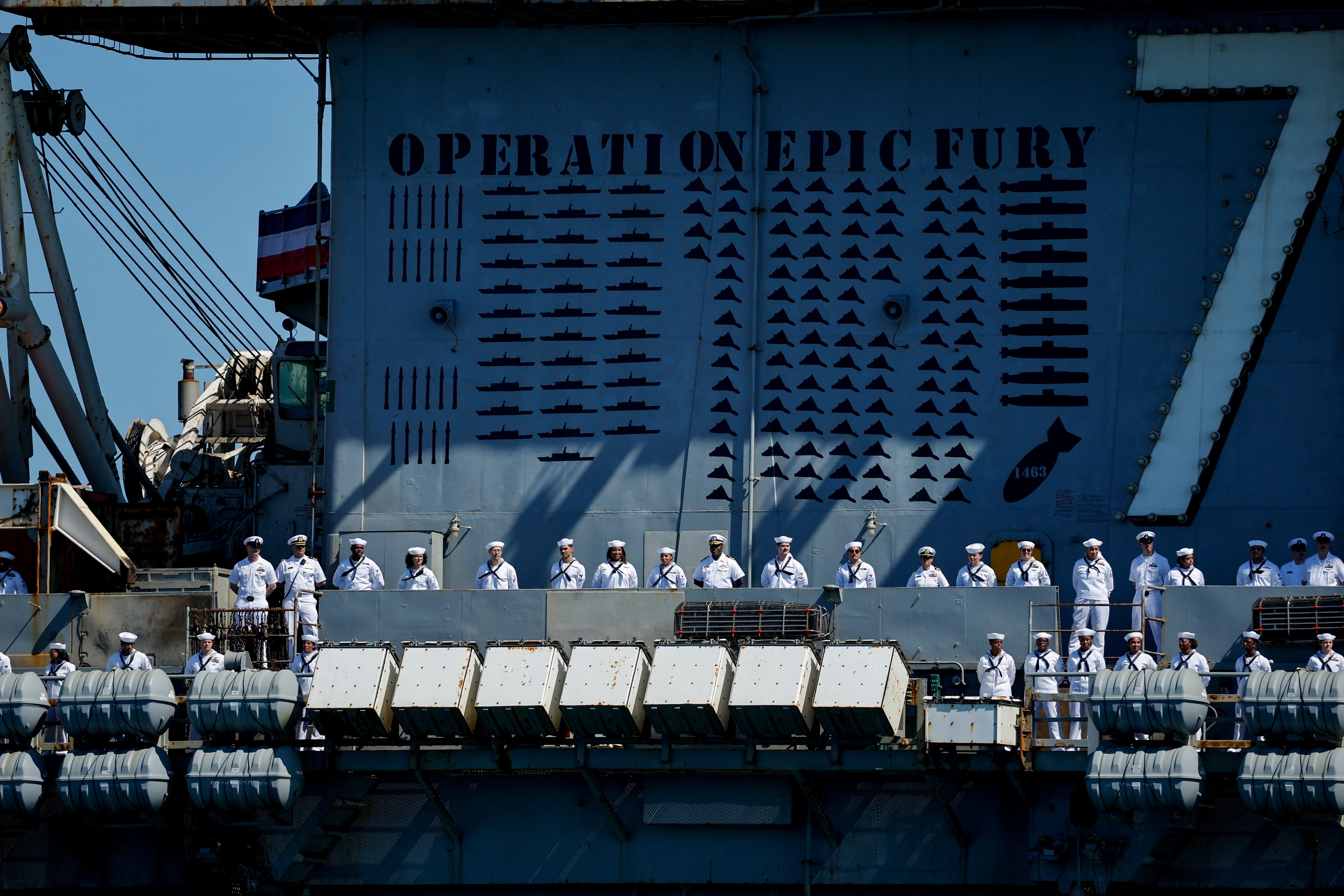
With dust still settling from a U.S. and Israeli air, land and sea bombardment on targets across the Islamic Republic — part an operation dubbed Epic Fury — Iran responded by firing hundreds of missiles and drones at U.S. bases that were “successfully defended against,” a CENTCOM release stated.
“There have been no reports of U.S. casualties or combat-related injuries,” the release stated. “Damage to U.S. installations was minimal and has not impacted operations.”
Video circulated earlier on Saturday purportedly showed the U.S. Navy’s 5th Fleet headquarters in Bahrain being hit in an Iranian strike.
At least 201 people have been killed and more than 700 injured across Iran, according to the Iranian Red Crescent Society.
The assault by U.S. and partner forces began Saturday at 1:15 a.m., CENTCOM officials stated, with the goal of knocking out “the Iranian regime’s security apparatus, prioritizing locations that posed an imminent threat.”
Among the primary targets of the operation were Islamic Revolutionary Guard Corps command and control facilities, Iranian air defense capabilities, missile and drone launch sites and military airfields, according to the statement.
The compound of Iran’s Supreme Leader Ayatollah Ali Khamenei was also targeted in the operation. A senior Israeli official told Reuters that Khamenei was killed in the strike, though the official status could not be confirmed as of press time.
“The president ordered bold action, and our brave soldiers, sailors, airmen, Marines, guardians and Coast Guardsmen are answering the call,” Adm. Brad Cooper, CENTCOM commander, said in a release.
The operation is the culmination of what CENTCOM officials called “the largest regional concentration of American military firepower in a generation.”
In addition to strikes carried out by U.S. fighter aircraft and naval vessels, the operation also saw the first combat use of the U.S. military’s new autonomous kamikaze drone.
The Low-cost Unmanned Combat Attack System, or LUCAS drone, is a one-way attack drone reverse-engineered after the Iranian Shahed-136.
Troops carrying out those strikes make up the newly formed Task Force Scorpion Strike squadron, a first-of-its-kind one-way-attack drone squadron led by U.S. Special Operations Command-Central personnel.
US confirms first combat use of LUCAS one-way attack drone in Iran strikes
The Low-cost Unmanned Combat Attack System, or LUCAS drone, is a one-way attack drone reverse-engineered after the Iranian Shahed-136.
U.S. Central Command officials have confirmed that airstrikes launched on Iran on Saturday involved the first combat use of the U.S. military’s new autonomous kamikaze drone.
The Low-cost Unmanned Combat Attack System, or LUCAS drone, was launched as part of Operation Epic Fury, which targeted Islamic Revolutionary Guard Corps command and control facilities, Iranian air defense capabilities, missile and drone launch sites and military airfields, CENTCOM officials announced.
“The president ordered bold action, and our brave soldiers, sailors, airmen, Marines, guardians, and Coast Guardsmen are answering the call,” Adm. Brad Cooper, commander of CENTCOM, said in the release.
The LUCAS platform is a one-way attack drone reverse-engineered after the Iranian Shahed-136.
Built by the Arizona-based SpektreWorks, the drone, which can be launched via catapults, rocket-assisted takeoff and mobile ground systems, is a spinoff of the company’s FLM 136 target model, one designed for counter-drone training while simulating Iran’s Shahed variant.
The FLM 136 model carries a range capability of around 500 miles, with a maximum payload of 40 pounds, or “roughly twice the explosive yield of a hellfire missile,” according to Alex Hollings, host of Sandboxx News’ FirePower.
With a maximum takeoff weight of 180 pounds, the FLM 136 is significantly lighter than the Iranian Shahed. The platforms are also immensely more cost-effective — and scalable — compared to the more advanced munitions in the U.S. arsenal, carrying a price tag of around $35,000 per unit.
A LUCAS drone was successfully launched from a ship for the first time in December, with personnel aboard the Independence-class littoral combat ship USS Santa Barbara carrying out an exercise in the Arabian Gulf, the Defense Department previously announced.
Those troops make up the newly formed Task Force Scorpion Strike squadron, a first-of-its-kind one-way-attack drone squadron led by U.S. Special Operations Command-Central personnel.
“This new task force sets the conditions for using innovation as a deterrent,” Cooper said in a December release. “Equipping our skilled warfighters faster with cutting-edge drone capabilities showcases U.S. military innovation and strength, which deters bad actors.”
The establishment of the task force in December followed a directive months earlier by Defense Secretary Pete Hegseth, “Unleashing U.S. Military Drone Dominance,” to accelerate acquisition and fielding of affordable autonomous systems throughout the military services.
“To simulate the modern battlefield, senior officers must overcome the bureaucracy’s instinctive risk-aversion on everything from budgeting to weaponizing and training,” Hegseth wrote in the July memo. “Next year I expect to see this capability integrated into all relevant combat training, including force-on-force drone wars.”
The Navy’s operations in U.S. Central Command comprise around 2.5 million square miles of ocean and include the Arabian Gulf, Gulf of Oman, Red Sea and parts of the Indian Ocean.
Competing with Dick Bong to be WWII’s top ace this pilot met a fateful end
Thomas McGuire Jr. was chasing Dick Bong's record when his life was cut short several months before war's end.
“On 7 January 1945, while leading a voluntary fighter sweep over Negros Island, he risked an extremely low altitude in an attempt to save a fellow flier from attack, crashed and was reported missing in action.” This was the last of several citations summarizing the deeds that added up to a Medal of Honor for Maj. Thomas McGuire Jr.
It also chronicles a culmination of ambition and hubris that ended the brilliant career of the second-ranking fighter pilot in the United States air services.
Born in Ridgewood, New Jersey, on Nov. 17, 1920, McGuire attended the Georgia School of Technology for three years, then enlisted in the U.S. Army Reserves as a flying cadet on July 12, 1941. On Feb. 2, 1942, he was rated a pilot and second lieutenant at Kelly Field, Texas.
While training at San Antonio, he met and married Marilynn Giesler, who he nicknamed “Pudgy,” a sobriquet that would appear on all his fighters thereafter.
From June 18 to Oct. 16, he flew Bell P-39Fs with the 56th Squadron, 54th Pursuit Group in Nome, Alaska, but on March 13, 1943, he was reassigned to warmer climes in the 9th Squadron, 49th Fighter Group, over Papua New Guinea.
Flying his first combat mission on April 22, McGuire was transferred to the newly formed 431st Squadron, 475th Fighter Group in July that year. Nicknamed “Satan’s Angels,” the 431st flew all over the South Pacific on missions that ranged from escorting bombers to making fighter bomber sweeps, according to the Department of Defense.
Flying the P-38H-1, he finally scored his first aerial successes on Aug. 13 — downing three enemy planes. The following day he shot down two more, becoming an ace in less than 48 hours.
He scored regularly from then on, becoming a first lieutenant that September.

On Oct. 17, 1943, he downed three Zekes over Oro Bay, raising his tally to 10, but was himself shot down and wounded. Parachuting 25 miles from Buna, he was rescued half an hour later by a patrol torpedo boat.
McGuire was promoted to captain on Dec. 10, and major on May 23, 1944. He held command of the 431st from May 2 to Dec. 23, then became group operations officer for the 475th.
By October that year, McGuire had shot down 24 enemy planes but was trailing Maj. Richard I. Bong whose tally was at 30.
At this point, McGuire had his eyes on surpassing Bong and the commander of the Far East Air Force, Lt. Gen. George C. Kenney, was inclined to encourage the rivalry, which brought attention to his Fifth and Thirteenth Air forces.
Kenney had known Bong before the war and favored him by making him weapons officer for V Fighter Command. In practice, it gave Bong a roving commission to fly and fight when and where he pleased. In contrast, McGuire took on all the responsibilities of command, while still finding time to shoot down enemy aircraft.

December 1944 saw the aces reach their peak. On Dec. 12, Bong was presented the Medal of Honor by Gen. Douglas MacArthur. But on Dec. 17, with Bong achieving his 40th aerial victory, Gen. Kenney ordered him to walk away from his P-38.
When McGuire shot down four Zekes on the 26th, raising his score to 38, Kenney grounded him to allow Bong one more crack at the title following his war bond tour back in the States.
Once Bong had finished his tour, however, Kenney unleashed McGuire, who gleefully resumed his patrolling.
On the morning of Jan. 7, 1945, McGuire led three P-38Ls over the area between the Philippine islands of Mindoro and Negros at an altitude of 1,500 feet.
There, Capt. Edwin Weaver spotted an enemy plane climbing toward them. McGuire and Weaver turned to attack it, but the Japanese Ki.43 evaded them and fired a burst of 12.7 mm bullets into the left engine of 1st Lt. Douglas S. Thropp Jr.’s P-38.
Thropp skidded, then straightened out and prepared to release his drop tanks.
“Daddy Flight, save your tanks,” McGuire ordered over the radio — confident that he could make short work of the enemy.
The fourth P-38, flown by a visiting 13th Air Force pilot, Maj. Jack Rittmayer, drove the Ki.43 off Thropp’s tail, but Japanese pilot pivoted to attack Weaver.
Hastening to Weaver’s aid, McGuire pulled his plane into a tight turn. Just as he was about to get his sights on the elusive enemy, his P-38 — weighted down from those extra fuel tanks — abruptly fell into a stall, snap-rolled onto its back and crashed in flames on Negros Island.
After 325 grueling missions, McGuire was reported as missing in action. Prior to his death the ace had earned the Distinguished Service Cross, the Silver Star, the Distinguished Flying Cross with four oak leaf clusters, 15 Air Medals and two Purple Hearts.
On March 7, 1946, for several outstanding actions, ending with his risking — and ultimately sacrificing — his life to save Weaver, he was posthumously awarded the Medal of Honor.
McGuire’s remains were discovered in 1949 in the jungles of Los Negros near a pineapple plantation, according to the DoD. In the same year, Fort Dix Army Air Field was renamed McGuire Air Force Base. McGuire’s remains were laid to rest in Arlington National Cemetery on May 17, 1950.
US, Israel launch ‘major combat operations’ in Iran
Discussing the potential of American casualties, Trump said "that often happens in war."
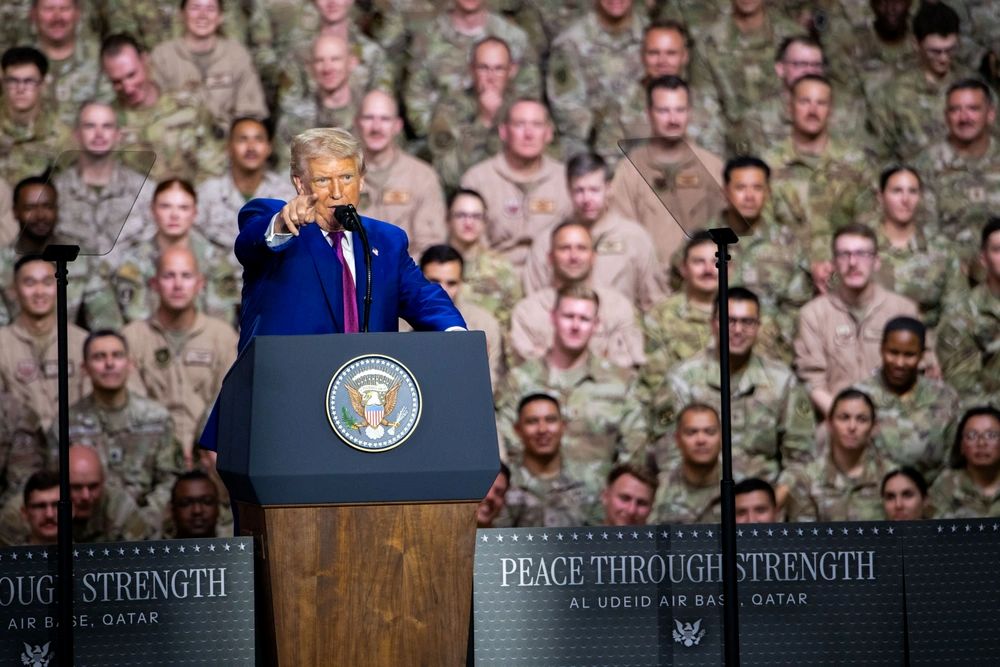
The U.S. and Israel launched a major attack on Iran on Saturday, with President Donald Trump calling on the Iranian public to “seize control of your destiny” and rise up against the Islamic leadership that has ruled the nation since 1979.
Some of the first strikes appeared to hit areas around the offices of Supreme Leader Ayatollah Ali Khamenei, and Iranian media reported strikes nationwide. Smoke could be seen rising from the capital. It wasn’t immediately clear whether the 86-year-old leader was in his offices at the time of the strike.
“When we are finished, take over your government. It will be yours to take. This will be probably your only chance for generations,” Trump said in a video announcing “major combat operations” were underway. “For many years, you have asked for America’s help, but you never got it.”
Israeli Prime Minister Benjamin Netanyahu echoed that sweeping goal. “Our joint operation will create the conditions for the brave Iranian people to take their fate into their own hands,” Netanyahu said.
The strikes opened a stunning new chapter in U.S. intervention in Iran and marked the second time in eight months that the Trump administration has used military force against the Islamic Republic. They also came just weeks after Trump ordered a military operation to capture Venezuela’s president, Nicolás Maduro, and bring him and his wife to New York to face federal drug conspiracy charges.
The operation also comes as tensions have soared in recent weeks as American warships moved into the region, and Trump said he wanted a deal to constrain Iran’s nuclear program at a moment when the country is struggling at home with growing dissent following nationwide protests.
Iran responded as it had been threatening to do for months — first launching a wave of missiles and drones targeting Israel. It followed with strikes targeting U.S. military installations in Bahrain, Kuwait and Qatar. The United Arab Emirates and Iraq shut down their airspace.
Iran’s Foreign Ministry issued a defiant statement, saying that the country “will not hesitate” in its response. In a statement posted on X, the ministry said: “The time has come to defend the homeland and confront the enemy’s military assault.”
Forty people were reported killed at a girls’ school in southern Iran in the Israeli-U.S. strikes, according to Iran’s state-run IRNA news agency. At least 45 others were wounded in the attack in Minab in Iran’s Hormozgan province.
The White House did not immediately respond to a request for comment on reported strike on the school.
Four people were also killed by an Iranian missile striking a building in Syria’s southern city of Sweida, according to Syrian state television.
Shrapnel from an Iranian missile attack on the capital of the UAE killed one person, state media said.

Attack was coordinated between Israel and US
The attacks came after weeks of the U.S. military massing forces in the region even as U.S. and Iranian envoys held talks in Switzerland and Oman aimed at finding a diplomatic solution to head off American military operation.
Oman’s Foreign Minister Badr al-Busaidi, a key mediator in the U.S.-Iran nuclear talks, said in a post on X that he was dismayed that U.S. and Israel moved forward with the operation.
“Active and serious negotiations have yet again been undermined,” said al-Busaidi, who traveled to Washington on Friday to meet with Vice President JD Vance for talks. “Neither the interests of the United States nor the cause of global peace are well served by this. And I pray for the innocents who will suffer. I urge the United States not to get sucked in further.”
Israel said the operation was carried out as a “broad, coordinated, and joint operation against the regime” that has been planned for months between the Israeli and U.S. militaries.
Trump, in justifying the military action, claimed that Iran has continued to develop its nuclear program and plans to develop missiles to reach the U.S.
He also acknowledged that there could be American casualties, saying “that often happens in war.”
It was a notable call on Americans to brace themselves from a U.S. leader who swept into office on an “America First” platform and vowed to keep out of “forever wars” that had bogged down his recent predecessors.
Trump’s statement indicated the U.S. was striking for reasons far beyond the nuclear program, listing grievances stretching back to the beginning of the Islamic Republic following a revolution in 1979 that turned Iran from one of America’s closest allies in the Middle East into a fierce foe.
The U.S. president said he was aiming to “annihilate” the Iranian navy and destroy regional proxies supported by Tehran.
He also called on the Iranian Revolutionary Guard to lay down its arms, pledging that members would be given immunity, while warning they would face “certain death” if they didn’t.
“They’ve rejected every opportunity to renounce their nuclear ambitions, and we can’t take it anymore,” Trump said.
Trump had threatened military action — but held off — following Iran’s recent crackdown on protests spurred by economic grievances and evolved into a nationwide, anti-government push against the ruling clerics.
The Human Rights Activists News Agency says it confirmed more than 7,000 deaths in the crackdown and that it is investigating thousands more. The government has acknowledged more than 3,000 killed, though it has undercounted or not reported fatalities from past unrest.
Iran has said it hasn’t enriched since June, but it has blocked international inspectors from visiting the sites America bombed during a 12-day war then. Satellite photos analyzed by The Associated Press have shown new activity at two of those sites, suggesting Iran is trying to assess and potentially recover material there.

Iran currently has a self-imposed limit on its ballistic missile program, limiting their range to 2,000 kilometers (1,240 miles). That puts all the Mideast and some of Eastern Europe in their range. There is no public evidence of Iran seeking to have intercontinental ballistic missiles, though Washington has criticized its space program as potentially allowing it to one day.
Iran had hoped to avert a war, but maintains it has the right to enrich uranium and does not want to discuss other issues, like its long-range missile program or support for armed groups like Hamas and Hezbollah.
The strikes could also have a huge impact on global markets, particularly if Iran is able to make the Strait of Hormuz unsafe for commercial traffic. More than 14 million barrels per day of oil passed through the strait in 2025, about a third of total worldwide oil exports transported by sea.
Strikes hit targets across Iran
Iranian media reported strikes nationwide. Roads to Khamenei’s compound in downtown Tehran had been shut down by authorities as other blasts rang out across the capital.
Khamenei has not made a public appearance in recent days and wasn’t immediately seen after. During the 12-day war in June, he was believed to have been taken to a secure location away from his Tehran compound.
In Tehran, witnesses heard the first blast by Khamenei’s office. Iranian state television later reported on the explosion, without offering a cause.
More explosions struck Iran’s capital after Israel said it was attacking the country. Authorities have offered no casualty information from the strikes.
Targets in the Israeli campaign included Iran’s military, symbols of government and intelligence targets, according to an official briefed on the operation, who spoke on condition of anonymity to discuss nonpublic information on the attack.
Iran retaliates
Hours after the strikes, Iran’s paramilitary Revolutionary Guard said it launched a “first wave” of drones and missiles targeting Israel, where a nationwide warning was issued as the military said it was working to intercept incoming Iranian missiles. There was no immediate word on any damage or casualties from the ongoing attack.
Meanwhile, Bahrain said that a missile attack targeted the U.S. Navy’s 5th Fleet headquarters in the island kingdom. Witnesses heard sirens and explosions in Kuwait, home to U.S. Army Central. Explosions could be also be heard in Qatar.
Iraq and the United Arab Emirates closed their airspace, and sirens sounded in Jordan.
Iraqi officials also reported a drone strike hit a headquarters of the Iran-backed Kataib Hezbollah militia in Iraq, killing two people and wounding three Saturday. The group had earlier threatened to enter the fray should Iran come under attack. An Israeli military official said Israel was not aware of any Israeli strikes on Kataib Hezbollah headquarters in Iraq.
The Iranian-backed Houthis in Yemen, meanwhile, vowed to resume attacks on Red Sea shipping routes and on Israel, according to two senior Houthi officials. They spoke on condition of anonymity because there was no official announcement from the Houthi leadership.
U.S. embassies or consulates in Qatar, United Arab Emirates and Israel posted on social media that they told staffers to shelter in place and recommended all Americans “do the same until further notice.”
Devil Dogs to follow slimmer waist-to-height standard than other branches
The U.S. Marine Corps has gone further in its waist-to-height ratio than the Department of Defense’s standards, making the new criteria 0.52 or less.
The U.S. Marine Corps has revised its body composition rules to go one step further than the Pentagon guidance released in January: Marines are expected to be slightly slimmer than the Department of Defense’s overall requirement.
Effective Jan. 1, 2026, Marines will be evaluated twice a year to ensure personnel meet the new waist-to-height ratio that is a bit lower than the Pentagon’s, according to a Marine Corps statement issued Thursday.
“The Marine Corps remains committed to upholding our warrior ethos, which requires being physically fit,” Gen. Eric Smith, Marine Corps commandant, said in the statement.
“This change to body composition program will help us balance the health and performance of our Marines,” Smith continued.
Starting in January, the Pentagon directed the military to utilize a waist-to-height ratio when evaluating the body fat of troops. Personnel are set to be evaluated twice a year, and their ratio is required to be no more than 0.55.
In accordance with that January announcement, the Corps is ordering their personnel to only contain a 0.52 or less waist-to-height ratio.
A waist-to-height ratio is calculated by dividing someone’s waist circumference by their height.
A man’s average height in the U.S. is around 5 feet, 7 inches tall with a waist circumference of 40.6 inches, according to the Centers for Disease Control and Prevention’s National Center for Health Statistics, which comes to a waist-to-height ratio of 0.59. The average height for a woman is approximately 5 feet, 2 inches tall with a waist of 38.5 inches, which makes the waist-to-height ratio 0.61.
The 0.52 standard is the same for all Marines, regardless of their sex or age, the release states.
“The WHtR standard of less than or equal to 0.52 balances health with performance, serving as an early risk screening threshold that allows the Marine Corps to identify and evaluate Marines before they approach higher cardiometabolic risk levels,” the release reads.
Marines who exceed 0.52 will be required to undergo a body fat evaluation using the tape test or through bioelectrical impedance analysis, the release states.
A BIA is a test that passes low-level electrical currents through the body to measure tissue resistance to evaluate lean muscle mass versus body fat.
Once “appropriate fielding” is accomplished for the BIA test, it will replace the tape test completely for body fat evaluation, the announcement reads.
If a Marine exceeds the set standards, they will be enrolled in the Marine Corps Body Composition Program, the memo says, regardless of the physical fitness test and combat fitness test scores.
Marines who score 285 points or higher on both their physical fitness test and combat fitness test will have a body fat exception that is capped at 26% for males and 36% for females, the release says.
The current additional 1% body fat allowance for Marines scoring 250 points or higher on both tests will stay in place but can not exceed the cap of 26% for males and 36% for females, the memo reads.
Marines who previously completed a height-and-weight evaluation between Jan. 1 and the Thursday release of a Marine Administrative Message, or MARADMIN, will need to be reevaluated using the waist-to-height ratio method, the release states.
The service will also reevaluate Marines that were assigned to the Body Composition Program on or after Jan. 1 using the waist-to-height ratio, and if they are within the standard, their program assignment will be “deleted as erroneous,” the MARADMIN says. If a Marine is outside the standard, their program assignment will continue, according to the message.
The Corps is planning a comprehensive body composition study this year to “assess and refine physical standards and evaluations,” the memo says.
Read the full MARADMIN here to see each height and its corresponding maximum waist size.
Stick to your guns: Why the Marine Corps is opting for the M27 over the Army’s M7
The M27 IAR is chambered for 5.56mm NATO legacy cartridge, while the M7 rifle is chambered for the larger and more modern 6.8mm round.
The Marine Corps is opting to keep the M27 Infantry Automatic Rifle rather than adopt the Army’s higher caliber M7, a service spokesperson confirmed in an email to Military Times.
Lt. Col. Eric Flanagan, a public affairs officer for Marine Corps Combat Development Command, confirmed the decision, stating the M27 is well-suited “for our close combat formations as it best aligns with our unique service requirements, amphibious doctrinal employment of weapons and distinct modernization priorities.”
Flanagan added that the M27 ensures “seamless interoperability across the Joint force and with coalition partners.”
“We will continue to monitor development of the M7 NGSW-R to inform future requirements,” he said.
Task & Purpose was the first to report the service’s decision.
The Marine Corps previously recanted an announcement that it would be replacing the M27 with the Next Generation Squad Weapon, the precursor to the M7, which may have fueled speculation. The Army, meanwhile, recently began fielding the M7 in the 25th Infantry Division in Hawaii.
When comparing the two weapon systems, notable differences emerge in features, operations, weight and cost. However, the most obvious difference between the two is their chambering, which impacts performance and ammunition capacity.
The M27 IAR is chambered for 5.56mm NATO, a legacy cartridge used by the weapon’s predecessors, the M4, M16 and M249 Squad Automatic Weapon. The smaller round also allows the M27 to use the same 30-round magazine as its predecessors.
The M7 rifle is chambered for the larger and more modern 6.8mm cartridge. The higher-pressure round delivers a longer range and greater penetration, but also results in fewer rounds per magazine — 20 instead of 30.
While military weapon enthusiasts may debate the difference between the two systems, both branches have cited reasons for selecting their rifles.
The Marines, for instance, initially selected the M27 to replace the M249 SAW because it delivered automatic fire with greater precision and reliability. The service then opted to make it standard issue in 2018 for all Marines because of its ease-of-use and effectiveness in a wide range of combat scenarios.
The Army, on the other hand, selected the M7 because it delivers greater penetration, including body armor penetration, at longer distances, meaning it delivers greater overall “lethality.”
Unlike the Marines’ one-size-fits-all approach, the Army equips squads with both the M7 rifle and the M250 light machine gun, which can be equipped with a higher capacity magazine.
US military uses laser to take down CBP drone, lawmakers say
The case of mistaken identity prompted the FAA to close additional airspace around Fort Hancock, about 50 miles southeast of El Paso.
The U.S. military on Thursday used a laser to shoot down a “seemingly threatening” drone flying near the U.S.-Mexico border. It was subsequently revealed that the drone belonged to Customs and Border Protection, lawmakers said.
The case of mistaken identity prompted the Federal Aviation Administration to close additional airspace around Fort Hancock, about 50 miles southeast of El Paso. The military is required to formally notify the FAA when it takes any counter-drone action inside U.S. airspace.
It was the second time in two weeks that a laser was fired in the area. The last time it was CBP that used the weapon and nothing was hit. That incident occurred near Fort Bliss and prompted the FAA to shut down air traffic at El Paso airport and the surrounding area. This time, the closure was smaller and commercial flights were not affected.
Washington U.S. Rep. Rick Larsen and two other top Democrats on the House Transportation and Infrastructure and Homeland Security committees said they were stunned when they were officially notified.
“Our heads are exploding over the news,” the lawmakers said in a joint statement. They criticized the Trump administration for “sidestepping” a bipartisan bill to train drone operators and improve communication among the Pentagon, FAA and Department of Homeland Security, which includes CBP.
“Now, we’re seeing the result of its incompetence,” they said.
Government defends use of anti-drone laser
The FAA, CBP and the Pentagon issued a joint statement late Thursday that acknowledged the military “employed counter-unmanned aircraft system authorities to mitigate a seemingly threatening unmanned aerial system operating within military airspace.”
The statement said it happened far from populated areas and commercial flights as part of the administration’s efforts to strengthen protections at the border.
“At President Trump’s direction, the Department of War, FAA, and Customs and Border Patrol are working together in an unprecedented fashion to mitigate drone threats by Mexican cartels and foreign terrorist organizations at the U.S.-Mexico Border,” the statement said.
Second time this month laser systems shut down Texas airspace
The El Paso shutdown two weeks ago lasted only a few hours, but it raised alarm and led to a number of flight cancellations in the city of nearly 700,000 people.
In that case, an anti-drone laser was deployed by CBP without coordinating with the FAA, which then decided to close the El Paso airspace to ensure commercial air safety, according to sources familiar with what happened who were not authorized to discuss it.
Afterward, members of Congress said it appeared to be another example of different agencies failing to coordinate with each other.
Transportation Secretary Sean Duffy said he was planning to brief members of Congress about the incident. He said at an unrelated news conference last Friday that it wasn’t a mistake for the FAA to close the airspace in El Paso and that he doesn’t think it was a communication issue that led to the problems.
Lawmaker demands an investigation
Illinois Democratic U.S. Sen. Tammy Duckworth, the ranking member on the Senate’s Aviation Subcommittee, called for an independent investigation.
“The Trump administration’s incompetence continues to cause chaos in our skies,” Duckworth said.
The investigation into last year’s midair collision near Washington, D.C., between an airliner and Army helicopter that killed 67 people highlighted how the FAA and Pentagon were not always working well together.
The National Transportation Safety Board said the FAA and the Army did not share safety data with each other about the alarming number of close calls around Reagan National Airport and failed to address the risks.
Drones already causing problems along the border
Cartels routinely use drones to deliver drugs across the Mexican border and surveil Border Patrol officers. Officials told Congress last summer that more than 27,000 drones were detected within 1,600 feet of the southern border in the last six months of 2024.
The threat to planes from drones continues to increase along with the number of near misses around airports. Homeland Security estimates there are more than 1.7 million registered drones flying in the United States.
Anti-drone systems can use radio signals to jam drones, or high-powered microwaves or laser beams like the ones that have been used in Texas that are capable of disabling the machines. Some others station small drones to take flight quickly and ram into threatening drones. There are also systems that deploy ammunition, but those are more common on battlefields than in domestic use.
Anthropic ‘cannot in good conscience accede’ to Pentagon’s demands, CEO says
Anthropic CEO Dario Amodei said Thursday the AI company “cannot in good conscience accede” to the Pentagon’s demands to allow wider use of its technology.
Anthropic CEO Dario Amodei said Thursday the artificial intelligence company “cannot in good conscience accede” to the Pentagon’s demands to allow wider use of its technology.
The maker of the AI chatbot Claude said in a statement that it’s not walking away from negotiations, but that new contract language received from the Defense Department “made virtually no progress on preventing Claude’s use for mass surveillance of Americans or in fully autonomous weapons.”
The Pentagon’s top spokesman has reiterated that the military wants to use Anthropic’s artificial intelligence technology in legal ways and will not let the company dictate any limits ahead of a Friday deadline to agree to its demands.
Sean Parnell said Thursday on social media that the Pentagon “has no interest in using AI to conduct mass surveillance of Americans (which is illegal) nor do we want to use AI to develop autonomous weapons that operate without human involvement.”
Anthropic’s policies prevent its models, such as its chatbot Claude, from being used for those purposes. It’s the last of its peers — the Pentagon also has contracts with Google, OpenAI and Elon Musk’s xAI — to not supply its technology to a new U.S. military internal network.
Parnell said the Pentagon wants to “use Anthropic’s model for all lawful purposes” but didn’t offer details on what that entailed. He said opening up use of the technology would prevent the company from “jeopardizing critical military operations.”
“We will not let ANY company dictate the terms regarding how we make operational decisions,” he said.
During a meeting on Tuesday between Defense Secretary Pete Hegseth and Amodei, military officials warned that they could cancel Anthropic’s contract, designate the company as a supply chain risk, or invoke a Cold War-era law called the Defense Production Act to give the military more sweeping authority to use its products, even if the company doesn’t approve.
Amodei said Thursday that “those latter two threats are inherently contradictory: one labels us a security risk; the other labels Claude as essential to national security.”
Parnell left out the threatened use of the Defense Production Act in the Thursday post on X and said Anthropic has “until 5:01 PM ET on Friday to decide.”
“Otherwise, we will terminate our partnership with Anthropic and deem them a supply chain risk,” he wrote.
The talks that escalated this week began months ago. Amodei said that given “the substantial value that Anthropic’s technology provides to our armed forces, we hope they reconsider.” But if they don’t, he said Anthropic “will work to enable a smooth transition to another provider.”
Sen. Thom Tillis, a North Carolina Republican who is not seeking reelection, said Thursday that the Pentagon has been handling the matter unprofessionally while Anthropic is “trying to do their best to help us from ourselves.”
“Why in the hell are we having this discussion in public?” Tillis told reporters. “This is not the way you deal with a strategic vendor that has contracts.”
He added, “When a company is resisting a market opportunity for fear of negative consequences, you should listen to them and then behind closed doors figure out what they’re really trying to solve.”
Sen. Mark Warner of Virginia, the ranking Democrat on the Senate Intelligence Committee, said he was “deeply disturbed” by reports that the Pentagon is “working to bully a leading U.S. company.”
“Unfortunately, this is further indication that the Department of Defense seeks to completely ignore AI governance,” Warner said in a statement. It “further underscores the need for Congress to enact strong, binding AI governance mechanisms for national security contexts.”
As Pentagon officials say they always will follow the law with their use of AI models, Hegseth told Fox News last February, weeks after becoming defense secretary, that “ultimately, we want lawyers who give sound constitutional advice and don’t exist to attempt to be roadblocks to anything.”
Associated Press writer Ben Finley contributed to this report.
US military assembles largest force of warships, aircraft in Middle East in decades
The U.S. Navy will have at least 16 ships in the region, dwarfing the 11-ship fleet that was, until the Ford’s departure, positioned in the Caribbean Sea.
The Pentagon is building up the largest force of American warships and aircraft in the Middle East in decades, including two aircraft carrier strike groups, as President Donald Trump warns of possible military action against Iran if talks over its nuclear program fall apart.
“It’s proven to be, over the years, not easy to make a meaningful deal with Iran, and we have to make a meaningful deal,” Trump has said. “Otherwise bad things happen.”
Trump likely will have a host of military options, which could include surgical attacks on Iran’s air defenses or strikes focused on Supreme Leader Ayatollah Ali Khamenei, experts say. But they warn that Iran could retaliate in ways it did not after attacks last year by the United States or Israel, potentially risking American lives and sparking a regional war.
“It will be very hard for the Trump administration to do a one-and-done kind of attack in Iran this time around,” said Ali Vaez, an Iran expert at the International Crisis Group. “Because the Iranians would respond in a way that would make all-out conflict inevitable.”
Trump has repeatedly threatened to use force to compel Iran to agree to constrain its nuclear program and, earlier, over Tehran’s bloody crackdown on nationwide protests.
Aircraft carriers bolster US presence
The aircraft carrier USS Abraham Lincoln and three guided-missile destroyers have been in the Arabian Sea since the end of January after being redirected from the South China Sea.

The strike group, which brought roughly 5,700 additional service members to the region, bolstered the smaller force of a few destroyers and three littoral combat ships already in the region.
Two weeks later, Trump ordered the world’s largest aircraft carrier, the USS Gerald R. Ford, along with three destroyers and more than 5,000 additional service members to head there.
This will bring the Navy’s presence in the region to at least 16 ships and it will dwarf the 11-ship fleet that was, until the Ford’s departure, stationed in the Caribbean Sea.
More aircraft have arrived
Numerous additional U.S. fighter jets and support aircraft also have touched down in the Middle East and bases in Europe.
More than 100 fighter jets, including F-35s, F-22s, F-15s and F-16s, left bases in the U.S. and Europe and were spotted heading toward the Middle East by the Military Air Tracking Alliance. That team of about 30 open-source analysts routinely analyzes military and government flight activity.
It says it also has tracked more than 100 fuel tankers and over 200 cargo planes heading into the region and bases in Europe in mid-February.
Adding to that force, the U.S. has moved 12 F-22 fighter jets to a base in Israel, according to a U.S. official who spoke on condition of anonymity to detail sensitive military movements.
Satellite photos from Planet Labs PBC of Muwaffaq Salti Air Base in Jordan that were analyzed by The Associated Press showed more than 50 aircraft, nearly all likely part of the American buildup. There could be more in hangars.
Steffan Watkins, a researcher based in Canada and a member of the MATA, said he also has tracked support aircraft, like six of the military’s early-warning E-3 aircraft, head to a base in Saudi Arabia. Those are key for coordinating operations with a large number of aircraft.

The massive wave was preceded by the arrival of Air Force F-15E Strike Eagles. U.S. Central Command said on social media that the fighter jet “enhances combat readiness and promotes regional security and stability.”
At the time, analysts of flight-tracking data also noticed dozens of U.S. military cargo planes heading to the region.
The activity is similar to last year when the U.S. moved in air defense hardware, like a Patriot missile system, in anticipation of an Iranian counterattack after the June bombing of three key nuclear sites.
Iran launched more than a dozen missiles at Al Udeid Air Base in Qatar days after the strikes.
Expectations of retaliation
Seth Jones, a defense expert at the Center for Strategic and International Studies, said it’s important to note that the U.S. is not deploying a major ground force.
The U.S. deployed more than 500,000 troops during Operation Desert Storm in the early 1990s and roughly 250,0000 American forces in Iraq in 2003.
“So, there are substantial limits to the force package,” he said of the current military assets in the region.
The U.S. military buildup is technically the region’s largest since the 2003 invasion of Iraq, even though the resources moved for the war dwarfed current assets, said Michael O’Hanlon, a defense and foreign policy analyst at the Brookings Institution.
O’Hanlon said the U.S. could simply use long-range B-2 bombers, as it had in June, if it wanted only to strike what is left of Iran’s nuclear program. The forces in place now are clearly designed for attacking targets in Iran and defending against retaliation.
Many likely expect Iran to “just keep firing drones and cruise missiles back at Israel and American bases in regard to almost anything we might do,” O’Hanlon said. But he said Iran could go bigger and broader, especially if its leadership feels targeted.
Vaez, the Iran expert at the International Crisis Group, said Iran is unlikely to limit its response as it did after the U.S. struck its nuclear facilities in June. Iran had signaled when and how it would retaliate with the attack on the military base in Qatar, allowing American and Qatari air defense to be ready and doing little damage.
“They have now come to the conclusion that the only way that they can stop this cycle is to draw blood and to inflict significant harm on the U.S. and Israel, even if that comes at a very high price for themselves,” Vaez said.
Behnam Ben Taleblu, Iran program senior director at the Washington-based Foundation for Defense of Democracies, said Iran is still believed to have ballistic missiles that can strike its enemies in the region.
“The Islamic Republic may think that would be a deterrent to Trump, whereas in reality, that might be an inducement to move the president from a limited operation to a larger one,” said Taleblu, whose think tank has long been critical of Iran and has been sanctioned by Tehran.
What to know about Defense Protection Act and the Pentagon’s Anthropic ultimatum
Anthropic CEO Dario Amodei repeatedly has made clear his ethical concerns about unchecked government use of AI.
Defense Secretary Pete Hegseth gave Anthropic an ultimatum this week: Open its artificial intelligence technology for unrestricted military use by Friday, or risk losing its government contract.
Defense officials in the Trump administration also warned they could designate Anthropic, which makes the AI chatbot Claude, as a supply chain risk — or invoke a Cold War-era law called the Defense Production Act to give the military more sweeping authority to use its products, even if the company doesn’t approve.
Some experts say that using the law this way would be unprecedented, and could bring future legal challenges. The government’s efforts to essentially force Anthropic’s hand also underscore a wider, contentious debate over AI’s role in national security.
Here’s what we know.
What is the Defense Production Act?
The Defense Production Act gives the federal government broad authority to direct private companies to meet the needs of national defense.
The act was signed by President Harry S. Truman in 1950, amid concerns about supplies and equipment during the Korean War. But over its now decades-long history, the law’s powers have been invoked not only in times of war but also for domestic emergency preparedness as well as recovery from terrorist attacks and natural disasters.
One of the act’s provisions allows the president to require companies to prioritize government contracts and orders deemed necessary for national defense, with the goal of ensuring the private sector is producing enough goods needed to meet a war effort or other national emergency.
Other provisions give the president the ability to use loans and additional incentives to increase production of critical goods, and authorize the government to establish voluntary agreements with private industry.
The DPA is “one of the government’s most powerful and adaptable industrial policy tools,” said Joel Dodge, an attorney and the director of industrial policy and economic security at the Vanderbilt Policy Accelerator.

Anthropic is the last of its AI peers to not supply its technology to a new U.S. military internal network. Its CEO Dario Amodei repeatedly has made clear his ethical concerns about unchecked government use of AI, including the dangers of fully autonomous armed drones and of AI-assisted mass surveillance that could track dissent.
The Defense Department is considering invoking the DPA to give the military more authority to use Anthropic’s products, even if the company doesn’t approve of how, according to a person familiar with the matter and a senior Pentagon official.
That could mean forcing Anthropic to adapt its model to the Pentagon’s needs without built-in safety limits, or remove certain ethical restrictions from the company’s contract language.
Experts like Dodge say both would be “without precedent under the history of the DPA.”
“It’s a powerful law,” he said. ”(But) it has never been used to compel a company to produce a product that it’s deemed unsafe, or to dictate its terms of service.”
How has this law been used in the past?
Trump in his first term and former President Joe Biden invoked the DPA to boost supplies to combat the COVID-19 pandemic. And during 2022’s nationwide baby formula shortage, Biden used the law to speed production of formula and authorize flights to import supply from overseas.
Biden also invoked the DPA in a 2023 executive order on AI, notably in efforts to require that companies share safety test results and other information with the government. Trump repealed the order at the start of his second term.
Decades ago, the administrations of both President Bill Clinton and George W. Bush used the DPA to ensure that electricity and natural gas shippers continued supplying California utilities amid an energy crisis.
And the law was used after Hurricane Maria struck Puerto Rico in 2017 to prioritize contracts for food, bottled water, manufactured housing units and the restoration of electrical systems.
The DPA requires periodic reauthorization to remain in effect, which can expand or refine the scope of the law. According to congressional documents, its next expiration date is slated for Sept. 30 of this year. And depending on how the Defense Department’s reported demands unfold, Anthropic could be at the top of lawmakers’ minds.
Possible next steps for Anthropic
If the Defense Department uses the DPA provision aimed at prioritizing government contracts and ordering production of certain goods — which the Anthropic case suggests it will — a company can push back if the requested product isn’t something it already produces, Dodge and others say, or if it deems the terms to be unreasonable.
But the government may try and overrule that, notes Charlie Bullock, senior research fellow at the Institute for Law & AI.
“If neither side backs down, it seems realistic that there would be litigation between Anthropic and the government,” Bullock said.
Some have also noted tension between the Pentagon’s warning that it could designate Anthropic as a supply chain risk while also indicating that its products are so important to national defense that it needs to invoke the DPA — two assertions that seem at odds with each other.
“There are a lot of forces that I think the administration’s counting on that would lead Anthropic to just give in on Friday and agree with its terms,” Dodge said.
If there’s future litigation over a potential DPA order, Dodge doesn’t expect the government to prevail because “it seems very out of bounds under the text of the law.”
But if the administration is successful, or Anthropic simply agrees to new terms, that could open up “a Pandora’s box of what the government could do to assert power and control over private companies,” he added.
VA to formally rescind controversial disability ratings rule
A policy requiring VA medical examiners to include effects of medication in assigning disability ratings is expected to be formally rescinded on Feb. 27.
A regulation that would have required Veterans Affairs medical examiners to include the effects of medication in assigning disability ratings is expected to be rescinded formally on Feb. 27.
According to an advanced Federal Register notice, the rescission will be effective immediately on publication, expected early Friday morning.
In the notice, VA officials said that while the rule was meant to clarify existing policy, “stakeholders have expressed uncertainty” about its impact on claims and leaving the rule in place during the codification process “could undermine confidence in the benefits system.”
“VA always takes veterans’ concerns seriously and recognizes that many commenters construed the interim final rule as something that could result in adverse consequences,” the notice read.
The rule, published Feb. 17, generated significant backlash from veterans, advocacy groups and lawmakers who said the proposal could have financially penalized veterans who adhere to medical treatment or encourage those seeking a disability rating to forego medications prior to a compensation and pension exam, putting their health at risk.
The VA said the regulation simply formalized a practice that has been in place since 1958. Officials said it was needed because a 2025 court ruling, Ingram v. Collins, decided the VA must discount the positive impact of medication when issuing a disability rating.
The rule stated that the methodology dictated by the courts set a standard that was “unquantifiable, hypothetical [and] unwarranted.”
The major veterans groups, including Disabled American Veterans, the Veterans of Foreign Wars and American Legion strongly objected to ruling, which they said was crafted without any input from veterans outside the VA.
Nearly 20,000 veterans and advocates have flooded the Federal Register’s comment section on the rule, saying it would hurt veterans.
“As a former Army nurse, it seems this rule change could have unforeseen and harmful downstream effects for veterans, which is why it demands serious public scrutiny and possible legislative clarification from Capitol Hill,” VFW National Commander Carol Whitmore said in a statement shortly after the rule was published. “While VA has authority to amend the rating schedule, it must do so without adversely affecting veterans.”
Collins announced two days after publication that the rule would not be enforced. But it remained on the books, raising concerns among veterans.
At least one lawsuit was filed against the VA seeking to stop implementation and on Tuesday, 20 Democrat and independent lawmakers from the House and Senate wrote Collins asking the rule be revoked.
They said that leaving the rule on the books was causing veterans to “confront the unnecessary dilemma of continuing life-improving treatment for their conditions.”
“This rule forces veterans into an impossible choice: follow their prescribed treatment plan or risk losing their benefits,” wrote the lawmakers, including the ranking Democrats on the House and Senate Veterans Affairs Committees, Rep. Mark Takano of California and Sen. Richard Blumenthal of Connecticut.
In letter, the lawmakers said enforcement of the rule could have resulted in an estimated $23 billion in savings and objected to what they said was a “political maneuver aimed at cutting costs.”
The VA has filed an appeal to the Ingram v. Collins ruling, and the rescission does not resolve that court case which continues.
In the notice to be published Friday, officials said the department is “committed to its mission of ensuring that every claimant applying for benefits — especially veterans who have earned disability compensation through their honorable service to the Nation — receives all benefits to which they are entitled under the law as expeditiously as possible.”
Lucky 13: A last-minute swap saved this airman’s life during WWII bombing run
Navigator Ed Ryan set off on his 13th bombing run on Friday the 13th, 1944. It would be his last.
The day began ominously.
It was Friday the 13th when the airmen of the 451st Bomb Group of the 15th Air Force based in Castelluccio, Italy, gathered in an ancient wine cellar which housed Group Operations.
“Gentlemen, our target today will be … Vienna,” Ed Ryan later recalled in Veteran Voices Magazine. Audible groans could be heard throughout the cellar. Experienced crewman knew how well defended the Austrian city was, laced with anti-aircraft guns.
Ryan, who served as a navigator, knew too, as he had flown 12 missions prior to that October day. It would be his 13th bombing run — set on the 13th.
“Friday, October 13, 1944: Friday the 13th. My lucky day,” Ryan wrote. “For the rest of my life, I would celebrate Friday the 13th whenever it appeared on the calendar. It was the day I should have died, but didn’t.”
It was overcast as Ryan’s B-24 took off, positioned in at the rear of the squadron. The men morbidly called it the “Purple Heart” position, as it left whoever was flying in that spot the most vulnerable to flak.
“I can’t say I was scared,” said Ryan. “I understood intellectually the odds of being shot down. But I never in my gut doubted that I would return from a mission. If it was going to happen, it would happen to another guy, not me. I was nineteen years old, too young to feel vulnerable.”
The target that day was a factory located in Floridsdorf, on the northern shore of the Danube, across from Vienna. As the B-24 approached its initial point, the crew’s top turret gunner, Dave Johnson, made a request.
He asked to come up to the nose to see the bombs drop. According to Ryan, Johnson had made that request on every mission — 12 times so far — and the crew “hated him for it.”
“Come on, guys, just let me come up, and I’ll return to the turret when we pull away from the target,” Ryan recalled the crew chief pleading.
“Our bombardier had finally had it,” Ryan recounted. “He turned and looked at me and chimed in on the interphone. ‘Oh, for Christ’s sake, let’s let him down here this one time, and that’ll be the end of it. He’ll see the drop, and that’ll be it. If he asks again, we’ll beat the hell out of him. You hear that, Dave?’”
Ryan, “snarl[ing] inwardly,” packed up his briefcase of charts and maps, unsnapped his parachute and squeezed past the “real jackass” Johnson.
“I was only nineteen, the youngest crew member by two years,” wrote Ryan. “If I had been older, I probably wouldn’t have allowed it, and I would have died that day.”
The last-minute swap saved Ryan’s life.
Less than 30 seconds after dropping its payload, the B-24 and its crew were hit simultaneously by three German 88s. The flak sheared off the entire nose of the plane and instantly killed the bombardier, the nose gunner and the crew chief.
With the bomb bay doors open, the pilot ordered Ryan to bail. The co-pilot had already dived headfirst out the door and the captain was urging the navigator to do the same.

The plane began to tilt wildly to and fro, and it was only then that Ryan noticed that the left side of his body was on fire. The plane lurched again and miraculously, Ryan’s unstrapped parachute flew towards him. Catching it, he slung it across the only side of his body not engulfed in flames and jumped.
Slamming his head against the catwalk that spanned the open bomb bay door, Ryan was knocked out cold. When he came to, he was in a free fall at 20,000 feet. Nonchalantly patting out the flames on his face and flight suit, Ryan began to see figures running beneath him. Bullets began to whiz by him and he terrifyingly realized he was “falling into the heart of the city I had just bombed.”
Ryan landed hard on city pavement and once again lost consciousness. When he came to, he recalled civilians were beating him with garden tools — “a shovel came down on my arm, I remember that,” he wrote.
The petrified American recalled that it was like looking through gauze, everything was hazy, tinged with red.
Shots rang out and German soldiers pushed through the crowd and hauled Ryan into the back of a truck where he once again lost consciousness.
When he awoke, he was in Luftwaffe Hospital 4/XVII.
“The left side of my face was badly burned, as was my hand, which was hardly recognizable,” Ryan wrote. “Where my flight suit covered skin, I was fine. Only the exposed parts were damaged. My left hand was bent grotesquely backward, the fingers curled so that the fingertips almost touched my forearm. I languished in what seemed like a hallway. After a few days, my burns became infected, and my hand began to putrefy.”
But Ryan’s luck was soon about to turn, as the smell of his putrefying flesh caught the attention of Dr. Josef Zikowski, head of the Robert Koch IV-A Infectious Disease Hospital in Vienna — which also housed deadly Nazi medical experiments.
Upon learning that Ryan was scheduled to have his left hand amputated the following morning, Zikowski arranged for Ryan’s transfer to the Koch Institute.
For the next three days, Zikowski, aided by two assistants “cut, scraped, and cleaned [Ryan’s] wounds for three days without cease. ... They sprayed a solution on to the burned skin tissue every five minutes for three days. I don’t know what was in the solution, but the treatment worked, and I began to heal,” Ryan wrote.
Surrounded by six other American airmen, Ryan soon discovered that none of them were sick — save for the nausea caused by the odor of his wounds, he quipped.
Zikowski and the nuns who worked beside him had struck a deal with the POWs. As the Allies continued to advance across Europe, particularly as the Soviets continued to inch closer to Vienna, the doctor struck a Faustian deal with the Americans.
Zikowski would falsify their records to prevent them from being shipped to POW camps and in return he wanted the Americans to vouch for him and his staff for when the Red Army inevitably marched into the city.
For the next five months Ryan and his fellow POWs subsisted on half-rations and what they managed to steal until one day in March 1945 the German guards simply disappeared.
The Soviets had arrived in the city.
Greeted with bear hugs and vodka, life under Red Army rule, however, was worse for Ryan than under the Germans.
“I saw drunken Russian soldiers shoot up whole rooms full of patients, regardless of sex or nationality. One April morning, while I was walking through a breezeway between buildings, bullets whizzed past my head, and I turned to see a Soviet soldier sitting outside on the lawn laughingly taking pot shots at me. He was drunk, and I sprawled to the floor to keep from getting hit.”
It was then that the Americans took fate into their own hands and simply walked out of the hospital, bound for Budapest, Hungary.
From there, Ryan and 30 other Americans were loaded into a C-47 en route to Foggia, Italy. It wasn’t until the plane was taxiing that Ryan allowed himself to believe that he was going to live.
Turning to fellow POW Claude Porter, Ryan sought to return to the United States by water.
“Flying is too dangerous,” he concluded.
New hypersonic missiles unveiled for fighter planes, ground systems
The medium-range hypersonic system is powered by a liquid rocket engine, is able to alter its speed in flight and can be adapted for use.
The U.S. will soon have the ability to deploy a new type of hypersonic missile that can be shot from fighter planes, bombers, ground-based launchers — and can even be fired from space.
Ursa Major, a Colorado-based defense manufacturer, debuted the HAVOC missile system on Tuesday.
The medium-range hypersonic system is powered by a liquid rocket engine, is able to alter its speed in flight and can be adapted for use with a wide variety of rocket motor systems from warplanes to vertical launch systems.
Additionally, the system can be deployed outside of Earth’s atmosphere, according to the company.
“Keeping pace with our adversaries requires more than exquisite systems. It requires speed to delivery, affordability, and the ability to build at scale,” Chris Spagnoletti, CEO of Ursa Major, said in a statement.
“The Ursa Major HAVOC Missile System delivers a highly capable hypersonic weapon designed from the start to be produced rapidly and in quantity, giving the warfighter a credible and adaptable capability.”
The system has a core module that makes it suitable for striking hypersonic targets as well, the company adds.
Hypersonic missiles, which fly at roughly five times the speed of sound, have become a priority across all U.S. military branches.
The Army, Air Force and Navy are all developing hypersonic missile programs, including: the Army’s Long-Range Hypersonic Weapon; the Air Force’s Hypersonic Attack Cruise Missile; and the Navy’s Conventional Prompt Strike programs.
While the services have aimed for hypersonic weapons since the early 2000s, development has lagged while Russia and China have gained advantages in this arena.
In a notable divergence, Russian and Chinese hypersonic missiles are designed to field nuclear warheads, while U.S. hypersonics are not.
“Most U.S. hypersonic weapons, in contrast to those in Russia and China, are not being designed for use with a nuclear warhead,” according to a Congressional Research Service report published last August.
The report predicted that U.S. hypersonics would “likely require greater accuracy and will be more technically challenging to develop than nuclear-armed Chinese and Russian systems,” while also noting that Russian and Chinese systems would have a potential advantage since nuclear weapons can inflict devastating damage without need for accuracy.
China has a robust hypersonic program and has conducted up to 20 times as many hypersonic missile tests than the U.S., and is also investing in underground facilities, per the report.
“Analysts disagree about the strategic implications of hypersonic weapons,” the report notes, adding that Congress has previously restricted funding due to concerns of nuclear escalation.
“Differences in threat perception and escalation ladders could thus result in unintended escalation,” the report concluded.
Military bases must bolster natural disaster planning to mitigate risks, report finds
A GAO report found that some military bases are still rebuilding parts of their facilities after natural disasters damaged them years ago.
The U.S. Department of Defense has not sufficiently tracked the cost of damages from extreme weather and natural disasters at military installations, hurting its ability to anticipate future disaster recovery needs, according to a U.S. Government Accountability Office report.
Over the past decade, extreme weather and natural disasters have cost the department over $15 billion in damages at military installations, which can affect the ability to execute its mission and impede the installation’s resources that support service members and their families, the 61-page report released Monday says.
At the request of Congress, the office conducted this report by investigating 12 installations that sustained “substantial damage” from a natural disaster from fiscal 2015 to fiscal 2024. The office conducted three in-person site visits, the report says.
The natural disasters that affected the installations examined included earthquakes, wildfires, floods, typhoons and hurricanes, among others.
The office examined the bases, reviewed their documentation and interviewed officials and found gaps in the department’s resilience planning despite previous improvements because of a lack of necessary data or adequate funding.
The report says that the department follows policy that reflects the statutory requirement to include resilience in the ongoing and planned construction projects at installations, but existing guidance does not address how installations should use the resilience plan information to recover from a disaster.
“By including such information in guidance, the military departments can help ensure that installations affected by disasters are better able to incorporate resilience improvements while quickly restoring essential capabilities,” the report reads.
The report highlights the severity of the damage natural disasters inflicted on the bases and the effects it had on their operations. For example, Tyndall Air Force Base in Florida is still impacted by the October 2018 Category 5 Hurricane Michael and its over $4 billion in damages.
The hurricane’s high-speed winds and storm surge flooding damaged all facilities on the base, and 60% of the base was damaged “beyond repair,” the report states. Recovery work, like military construction projects, is still underway and is expected to continue until 2027, per the report.
The office recommended that the department expand the scope of data collection on the costs and effects of extreme weather at installations and establish a process that updates the data as more information becomes available.
The office also recommends that the Army, Navy and Air Force issues guidance to bases on how to use “installation master plan resilience information” when recovering from a natural disaster.
The Defense Department concurred with each recommendation, according to the report.
Vets to VA: Formally rescind new disability ratings rule
Veterans want the VA to rescind a controversial regulation published Feb. 17 that put compensation ratings in legal limbo.
Veterans and lawmakers want the Department of Veterans Affairs to rescind a regulation published Feb. 17 that would have required VA medical examiners to consider the effectiveness of treatments or medication on a disability when determining a compensation rating.
VA Secretary Doug Collins promised Thursday that the department would not enforce the controversial rule, but it remains on the books. The legal limbo has alarmed veterans, advocacy groups and lawmakers who say the proposal must be revoked to guarantee it won’t be followed.
The rule stipulated that VA medical examiners base ratings evaluations on a veteran’s actual level of impairment during every day life.
If treatment lowered the level of disability, the associated rating would be based on the lowered disability level, according to the rule.
VA officials said the regulation rule formalized a practice that has been in place since 1958 and deemed it necessary because the VA faces reconsidering 350,000 claims decisions and retraining its medical examiners as a result of the 2025 Ingram v. Collins ruling.
Without it, they said, the department would see “an overall increase in compensation expenditures based on disability level that veterans are not actually experiencing.”
But veterans saw the announcement, which sidestepped the standard regulatory process, as a betrayal. As of Tuesday, more than 18,000 veterans, family members and organizations had commented on the regulation in the Federal Register, with many calling for its immediate rescission.
“Our nation should never balance its budget on the backs of those who have stood to defend it,” Disabled American Veterans National Commander Coleman Nee said during a hearing Tuesday. “No veteran should be penalized for taking the medication they need to survive.”
More then 20 lawmakers from the House and the Senate, namely Democrats and independents, wrote Collins Tuesday requesting the rule be revoked. They argued that leaving it on the books is causing veterans to “confront the unnecessary dilemma of continuing life-improving treatment for their conditions.”
“Medications help improve function and mask symptoms, but they do not eliminate the impacts of living with musculoskeletal disability, mental health conditions, spinal cord injuries and other health conditions,” wrote members of Congress, including the ranking Democrats on the House and Senate Veterans Affairs Committees, Rep. Mark Takano of California and Sen. Richard Blumenthal of Connecticut. “This rule forces veterans into an impossible choice: follow their prescribed treatment plan or risk losing their benefits.”
VA Deputy Secretary Paul Lawrence said Sunday that the VA had withdrawn the rule, although no revocation has been published in the Federal Register.
Speaking at the DAV’s Mid-Winter Conference in Arlington, Virginia, Lawrence affirmed Collins commitment to abandon the regulation.
“Candidly, we have no intention of ever doing anything or talking about it ever again,” Lawrence said.
But Lawrence also expressed disappointment in veterans’ reaction to and interpretation of the regulation, decrying any insinuation that VA leadership would use the regulatory process to cut benefits.
“If you look at our words and actions, we would never do that,” Lawrence said. “In our first year in office, we have processed more disability claims, we have granted more disability than ever, ever, ever in such a short period of time and so in that sense, we were just disappointed.”
Nee said veterans have concerns over any changes at the department — especially those done without input from veteran service organizations — because the VA faces a “defining crossroads,” needing to modernize without the “dismantling, fragmentation and gradual erosion” of the system.
“Acknowledging flaws is not the same as abandoning the mission. Calls to dismantle or significantly privatize the VA are often framed as pragmatic solutions offering veterans choice by shifting care to the private sector. On the surface, this may sound reasonable. In practice, it risks hollowing out the only healthcare system in this country that is purpose built for veterans,” Nee said.
In addition to the rule remaining on the books, the VA has filed an appeal to a decision in Ingram v. Collins, one of the court cases that decided the VA must discount the positive impact of medication when assigning disability ratings.
In the rule, VA officials said the department concluded that the Ingrams decision and previous rulings have “misconstrued the role of medication and treatment in evaluating functional impairment.”
Basing a disability rating without considering the effect of medication or treatment is “an unquantifiable, hypothetical, unwarranted standard that would compensate veterans for a level of disability they are not actually experiencing,” VA officials said.
Veterans organizations are in Washington, D.C. over the next several weeks lobbying Congress to support their legislative priorities, which for many include passage of a bill that would allow medically retired service members to collect their Defense Department retirement pay and VA disability compensation without offsets, improvements to the disability claims process and laws safeguarding veterans from companies that collect large fees from veterans for assistance with their claims.
Rita Graham, policy director for the Service Women’s Action Network, said her organization would like to see expanded fertility treatments for women veterans at the VA, improved research on the effects of military service on women — including toxic exposures — and recognition that women have served honorably in combat for a decade.
She added that the uproar over last week’s rule provided an opportunity for improved dialogue between groups like SWAN and the VA.
“SWAN would like to appreciate the VA’s reversal of the interim final rule on medication and disability ratings and hope this will lead to more transparency and congressional oversight for all future regulatory changes,” Graham said.
‘I did that until I ran out of gas’: An American advisor and his MoH actions in Vietnam
With the South Vietnamese breaking under a VC ambush, Jack Jacobs took charge.
The Vietnam War involved all manner of fighters, the quality of which varied on both sides. The communists ranged from local Viet Cong guerrillas to professional People’s Army of Vietnam (PAVN) soldiers and between them, VC trained in the northerners’ light infantry tactics.
Besides the well-trained service personnel from the United States, Australia, Philippines and Thailand, South Vietnam’s formal Army of the Republic of Vietnam (ARVN) and less consistent anti-communist Civilian Irregular Defense Group (CIDG) forces frequently went into battle accompanied by a handful of American advisors. Among those American advisors was Jack Jacobs.
Born in Brooklyn, New York, on Aug. 2, 1945, to a Jewish family of mixed Greek, Polish and Romanian heritage, Jacobs spent his childhood in Queens, near LaGuardia Airport and later in Woodbridge Township, New Jersey.
After graduating from Woodbridge High School, he earned a bachelor’s and master’s of arts at Rutgers University, while also training in the Reserve Officers Training Corps, from which he emerged with a second lieutenant’s commission in 1966.
From there, he did two tours as a first lieutenant attached to Military Assistance Command, Vietnam (infantry), serving as an advisor to the ARVN.
March 1968 saw Jacobs attached to the ARVN as assistant commander to the 2nd Battalion, 16th Infantry, 9th Infantry Division.
On March 9 his battalion was engaged in a search and destroy mission in Kien Phong Province. Just as it was getting in position to advance, however, the hunters became the hunted when the ARVN came under devastating fire from well-entrenched Viet Cong, some of whom were in well-positioned bunkers.
Jacobs called for air support and directed it as best he could, but as he moved up to the leading company, he found the battalion commander disabled and the troops — suffering heavy casualties — falling into disorganization.
Jacobs himself was struck by mortar fragments in the arms and head, which impaired his vision. Nevertheless, he took charge of the forward company and ordered a withdrawal to more secure terrain.
Once his troops had established a defensive perimeter, he ran forward over rice paddies and open ground to evacuate a seriously wounded American advisor to a wooded area, where he administered first aid to him. Jacobs then ran forward again, to retrieve the battalion commander.
That done, he advanced several more times to rescue 12 more wounded ARVN and their weapons. As his citation noted, on three separate occasions he “contacted and broke off Viet Cong squads who were searching for allied wounded and weapons, single-handedly killing three and wounding several others....through his effort the allied company was restored to an effective fighting unit and prevented defeat of their friendly forces by a strong and determined enemy.”
After the opposing sides disengaged, the courage and leadership Jacobs displayed in saving the 2nd Battalion from disaster resulted in his promotion to captain.
On Oct. 9, 1969, he was summoned to the White House, where President Richard M. Nixon awarded him the Medal of Honor.
“As for my own action,” Jacobs would later recount, “the enemy had spies in the province headquarters. So they knew we were coming; they had three days to set up an ambush, and we walked right into it. We lost a large number killed and wounded in the first seconds of the battle, including me.
“There were a lot of other soldiers who were out in the open. I was badly wounded too, but I was the only person who was in a position to do something. I thought it was my obligation to do what I could to get them out of there. So I went out and dragged some of them back, carried some of them back. The Viet Cong were coming out of their bunkers with supporting cover, taking the weapons from our dead and shooting the wounded. I did that until I ran out of gas; I sat down to catch my breath and I couldn’t get up again because I’d lost too much blood.”
Additionally, by the end of his tours, he received the Silver Star with bronze oak leaf cluster, the Legion of Merit, Bronze Star with “V” device and two oak leaf clusters and two Purple Hearts.
“I don’t think you can judge valor with any kind of regularity or equitability,” Jacobs wrote. “It’s a subjective evaluation, despite the fact that the services have tried to judge it in absolute or relative terms.... You either did something valorous or you did not. It makes it more equitable but also more inequitable once you start instituting gradations of valor.”
Over the course of his career, Jacobs would serve as a platoon leader in the 82nd Airborne Division, battalion executive officer in the 7th Infantry Division and a battalion commander in the 10th Infantry Regiment in Panama.
From 1973 to 1976 Jacobs served as a faculty member of the U.S. Military Academy, teaching international and comparative politics.
In 1987 he retired from the military as a colonel, then went into investment banking with various firms, including the Fitzroy Group in London. He was also vice chairman of the Medal of Honor Foundation, on the Board of Trustees for the National World War II Museum and McDermott Chair of Politics at the USMA.
In 2008 Jacobs wrote a memoir, “If Not Now, When?: Duty and Sacrifice in America’s Time of Need,” in collaboration with Douglas Century. It went on to win the Colby Award in 2010.
In 2012 Jacobs and David Fisher co-wrote “Basic: Surviving Boot Camp and Basic Training.” In 2016 Jacobs was inducted into the New Jersey Hall of Fame.
Among other things, Jack is still active as a commentator at NBC and MSNBC, and in the Code of Support Foundation.
Military dogs are facing substandard conditions, leading to deaths, report finds
An Office of the Inspector General report found that poor kennel conditions and a lack of enough caretakers can result in health issues, death.
Non-training military working dogs at bases across the country are facing neglectful conditions caused by aging facilities and a lack of ample caretakers, according to a U.S. Department of Defense Inspector General report.
The office conducted 12 site visits to military working dog programs and found that the department and the program’s manager did not sufficiently protect the dogs from extreme weather conditions, mold issues and did not manage quarantine and isolation areas well.
Many of the dogs are housed and trained in aging and unsatisfactory kennel facilities, with some constructed over 40 years ago, resulting in the death of four dogs from fiscal year 2021 through fiscal 2023, the 42-page report released on Feb. 17 said.
“DoD Service Component officials told us that the unsatisfactory kennel facility conditions occurred because the Service Component Commands did not prioritize renovation or new construction of the kennels over other mission requirements,” the report states.
The report determined that the department needs to improve the kennel facility conditions across the services because it can lead to canine health issues, injuries and behavioral challenges.
In their examination, the office focused on non-training dogs, those awaiting deployment, medical disposition or in training rejection status. Those in training status generally receive adequate physical activity and social and cognitive enrichment during their training.
The focus areas of the IG office were: health care; kenneling; mental and physical wellness; training and safety; and ethical and humane treatment for DoD MWDs retired from, or not selected for, active service, the report lists.
Currently, there are about 1,600 military working dogs across branches, and they all originate from the same base: the 341st Training Squadron at Joint Base San Antonio, Texas.
During the office’s August 2024 site visit, 230 of the military working dogs were in non-training status at the 341st Training Squadron.
The 341st Training Squadron is tasked with the initial acquisition, training and sustainment of the military working dogs and their handlers for all U.S. branches and select allied nations.
In an Air Force guidance memorandum referred to in the report, it lists the requirements for the military working dogs welfare in the 341st training environment, citing canine enrichment times, housing facilities and veterinary health services as a necessity for mission effectiveness.
“DoD MWDs’ physical, social, and cognitive needs must be met every day through enrichment,” the memo says.
“Rotation of the type of enrichment provided from each category shall be done to maintain novelty and engagement,” the guidance continues.
The report found that the training squadron did not provide those in non-training status with the required five hours per day of physical activity, social and cognitive enrichment as stated in the memo.
Instead, they walked the non-training status dogs for around 10 minutes, four times a week or less, the report says.
Out of the 230 in non-training status, 104 received four 10-minute walks for the week and the rest received three or less 10-minute walks for the week, according to the report.
In the office’s site visit to the 341st, they also observed canine behaviors that resulted from a lack of enrichment times, like stress behaviors and physical signs of heat stress. The report noted that the training squadron does not have enough caretakers to manage all those in non-training status.
The 341st kennel master told the office that they “could not meet the 5 hours of enrichment required because of manpower challenges,” the report says.
Even though the five hours of physical activity required is not met, the report details that all dogs are given five hours of holistic enrichment through inflatables, audio books, music and scented bubble machines.
The squadrons’ caretakers and trainers also told the office that they need additional manpower for their assigned husbandry and kennel management duties.
“Because of the manpower challenges, the Air Force requested FY 2025 funding to increase caretaker positions to support DoD MWD exercise and enrichment requirements,” the report reads.
Upgrading kennels can take years and cost millions of dollars, but kennel masters say they can tell the difference improved facilities have on the dogs’ health and morale.
The office made two recommendations for the Secretary of the Air Force and the defense department’s program manager. The first being to reduce the number of military working dogs in non-training status at the 341 Training Squadron until there are enough caretakers. The second being developing and implementing a plan to upgrade the kennel facilities to meet current standards.
All recommendations in the report are marked as resolved, meaning management has agreed to implement them or has proposed actions that will address the issues regarding the recommendations. They will be considered closed when the office verifies that the corrective actions were implemented.
Thanks but no thanks: Greenland declines Trump’s offer to send Navy hospital ship
Both of the U.S. Navy’s hospital ships are currently docked at a shipyard in Alabama.
U.S. President Donald Trump said he would deploy a hospital ship to Greenland, alleging that many people there are sick and not receiving care, even though both of the U.S. Navy’s hospital ships are currently docked at a shipyard in Alabama.
Trump’s announcement prompted a defense on Sunday of Denmark and Greenland’s health care system from their leaders, and it was the latest point of friction with the American leader who has frequently talked about seizing the massive Arctic territory.
“It’s a no thank you from here,” said Greenlandic Prime Minister Jens-Frederik Nielsen.
Trump’s social media post about a hospital ship came after Denmark’s military said its arctic command forces on Saturday evacuated a crew member of a U.S. submarine off the coast of Greenland for urgent medical treatment.
The Danish Joint Arctic Command, on its Facebook page, said the crew member was evacuated some 7 nautical miles (8 miles; 13 kilometers) off Nuuk — the capital of the vast, ice-covered territory — and transferred to a hospital in the city. The crew member was retrieved by a Danish Seahawk helicopter that had been deployed on an inspection ship.
Trump, in a post on his Truth Social platform on Saturday night, referred to his special envoy for Greenland and said, “Working with the fantastic Governor of Louisiana, Jeff Landry, we are going to send a great hospital boat to Greenland to take care of the many people who are sick, and not being taken care of there. It’s on the way!!!”
Nielsen said it wasn’t necessary.
“We have a public health care system where treatment is free for citizens. That is a deliberate choice — and a fundamental part of our society,” Nielsen said. “That is not how it works in the USA, where it costs money to see a doctor.”
He added, in a note of exasperation, that Greenland is always open to dialogue and cooperation. “But please talk to us instead of just making more or less random statements on social media,” he said.
Danish Defense Minister Troels Lund Poulsen, speaking to public broadcaster DR, said Danish authorities had not been informed that the U.S. ship was on its way.
The Pentagon referred questions about the status of the U.S. Navy’s two hospital ships, the USNS Mercy and USNS Comfort, to the White House. The White House did not immediately respond to repeated requests for more information.
Both ships are currently at a shipyard in Mobile, Ala., according to social media posts from the shipyard, which also posted photos of them next to each other.
When asked about the status of the ships and the president’s post, the Navy referred questions to the White House.
The historically strong bilateral ties after World War II between NATO allies Denmark and the United States have come under severe strain in recent months as Trump ratcheted up talk of a possible U.S. takeover of the mineral-rich and strategically located Arctic island.
Danish Prime Minister Mette Frederiksen defended Denmark’s health care system on Sunday, writing on Facebook that she was “happy to live in a country where there is free and equal access to health for all. Where it’s not insurances and wealth that determine whether you get proper treatment.”
“You have the same approach in Greenland,” she said, before adding: “Happy Sunday to you all” in front of a blushing, smiling emoji.
Aaja Chemnitz, one of the two Greenlandic politicians in the Danish parliament, wrote on Facebook that “Donald Trump wants to send a poorly maintained hospital ship to Greenland. It seems rather desperate and does not contribute to the permanent and sustainable strengthening of the health care system that we need.”
“Another day. Another crazy news story,” she wrote in front of a smiley face emoji.
Associated Press writer Michelle L. Price in Washington contributed to this story.
Airman, spouse indicted in fraud scheme, costing military millions
Richard Stefon Ramroop and his spouse, Manuel George Madrid, allegedly stole millions in taxpayer dollars from the DoD in a years-long scheme.
A pharmacy technician airman at the Davis-Monthan Air Force Base and his spouse were recently indicted in a plot to defraud the Department of Defense of millions of dollars in an effort to “curate and maintain a luxurious lifestyle.”
U.S. Air Force Staff Sgt. Richard Stefon Ramroop and his spouse, Manuel George Madrid, allegedly stole millions in taxpayer dollars from the department in a years-long scheme, according to a Justice Department statement released last week.
Prosecutors claim that the couple used Ramroop’s position at the Tucson, Arizona, base’s pharmacy to purchase thousands of medical devices using taxpayer funds and then stealing and reselling the devices for their own gain, defrauding the U.S. government.
“Fraud of this level is not just a financial crime, it undermines public trust, diverts resources, and threatens the integrity of our force,” Special Agent Richard Kautz, the Air Force Office of Special Investigations Detachment 217 commander, said in the release.
“Every dollar lost to fraud is a dollar taken away from the security of our nation,” Kautz continued.

On Feb. 11, the couple was indicted by a federal grand jury with 12 counts of conspiracy to commit theft of government property, conspiracy to commit wire fraud, wire fraud and money laundering, per the release.
The indictment asserts that Ramroop and Madrid used the proceeds to purchase luxury vehicles and real estate directly from their personal bank accounts, funded by the fraudulent medical device sales.
The release, complete with photos of the luxury vehicles the couple bought, states that in February 2024 the couple used the fraud funds to purchase a million-dollar home in Tucson, a new 2024 Porsche Cayenne Sport Utility Vehicle with the price tag of $141,443.34 and a new BMW i7 Sport Utility Vehicle for $195,397.59.
From January 2022 through 2025 the release claims that the couple deposited over $11 million in fraud proceeds into bank accounts they controlled.
To do this, Ramroop and Madrid utilized wire transfers, Automated Clearing House deposits and other credits from companies engaged in the resale of medical test strips and devices, per the statement.
The orders of the stolen medical devices cost the department over $3 million, the statement says.
In a Jan. 15 execution of a search warrant, the vehicles and other items were seized by law enforcement, according to the indictment.
Ramroop’s lawyer and the law office representing Madrid listed in the court filings did not immediately return a request for comment Monday.
The investigation was led by the IRS’s Criminal Investigations division, the Air Force Office of Special Investigations and members of the Homeland Security Task Force. The U.S. Attorney’s Office for the District of Arizona, Tucson, is tasked with the prosecution efforts.
If convicted, Ramroop and Madrid could face imprisonment of a maximum of five years for conspiracy to commit theft of government property, a money laundering penalty of up to 10 years for each count and up to 20 years for each count of conspiracy to commit wire fraud and wire fraud.
Trailer released for World War II drama ‘Pressure,’ starring Brendan Fraser
The new film tells the true tale of how the success of D-Day and Operation Overlord hinged upon a weather forecast.
On June 6, 1944, over 160,000 Allied troops were sent across the English Channel onto the beaches of Normandy, France, marking the assault on Western Europe. Yet the operation, dubbed Operation Overlord, almost ended in disaster before it even began.
Now, the upcoming film ”Pressure,” adapted from writer David Haig’s 2014 play of the same name, is set to relieve those angst-filled 72 hours leading up to D-Day.
The film stars Academy Award winner Brendan Fraser (“The Whale”) as Supreme Commander of the Allied Forces Dwight D. Eisenhower and Andrew Scott (“Fleabag”) as Group Captain James Stagg, the chief meteorologist who predicted the storms over Western Europe in the days leading up to the invasion.
In the latest trailer by Focus Features, “Pressure” depicts this true yet stranger-than-fiction story of Stagg’s unenviable task of predicting the English Channel’s notoriously fickle weather.
The lanky Brit, alongside a team of forecasters from the Royal Navy, British Meteorological Office and U.S. Strategic and Tactical Air Force, knew the Allies only had a small window — nine days in May and June — that were suitable for the invasion.
“The days needed to be long for maximum air power usage; a near-full moon was needed to help guide ships and airborne troops; and the tides had to be strong enough to expose beach obstacles at low tide and float supply-filled landing vehicles far onto the beach during high tide,” according to a DOD breakdown of D-Day. “H-Hour was also crucial in that it relied on those tides to be rising at that time. There also had to be an hour of daylight just beforehand for bombardment accuracy.”
Eisenhower set the date for the invasion to be June 5, but in the wee hours of June 4, 1944, Stagg recommended halting the 7,000 naval vessels — including battleships, destroyers, minesweepers, escorts and assault craft —carrying more than 160,000 troops.
The aptly titled “Pressure” depicts an anguished Eisenhower on the eve of the invasion, with the weight of the free world and the largest, most dangerous seaborne invasion in history all hinging on a weather report.
Stagg’s intel proved correct and a storm broke over the English Channel on June 5. However, further postponement would have meant a two-week delay. Stagg believed there would be a small break in the storm and, just before dawn 24 hours prior, Eisenhower made the decision to go on June 6.
If the titanic invasion wasn’t enough to fray Eisenhower’s nerves, just six weeks prior, on April 27–28, Exercise Tiger, the dress rehearsal for Operation Overlord, had gone hideously awry.
Taking place in Slapton Sands, England, friendly fire and German E-boats claimed the lives of more than 1,000 men and resulted in the worst loss of life for American troops since the Dec. 7, 1941, Japanese attack on Pearl Harbor.
In fact, five times more men died at Slapton Sands than were killed storming Utah Beach on D-Day. As a result of the rehearsal, however, the Allies learned valuable, though grim, lessons that would be essential to the success of the invasion.
Just several weeks after the invasion Stagg noted in a memo to Eisenhower that had the Allies postponed to later that June, they would have encountered the worst weather in the English Channel in two decades.
“I thank the Gods of War we went when we did,” Eisenhower wrote back.
Anthony Maras, who co-wrote the script with Haig, helmed the film that is set to arrive in theaters on May 29.
Danish military evacuates US submariner who needed urgent medical care off Greenland
The U.S. crew member was retrieved from the submarine about 8 miles off the coast of Nuuk, Greenland, by a Danish Seahawk helicopter.
Denmark’s military said its arctic command forces evacuated a crew member of a U.S. submarine off the coast of Greenland for urgent medical treatment.
The Danish Joint Arctic Command, on its Facebook page, said the crew member was evacuated on Saturday, some 7 nautical miles, or about 8 miles, off Nuuk — the capital of the vast, ice-covered territory — and transferred to a hospital in the city.
The crew member was retrieved by a Danish Seahawk helicopter that had been deployed on an inspection ship.
Also late Saturday, U.S. President Donald Trump announced plans to deploy a hospital ship to the Danish autonomous territory of Greenland, alleging that many people there are sick and not receiving care — prompting a defense of Denmark’s health care system from Prime Minister Mette Frederiksen.
“Working with the fantastic Governor of Louisiana, Jeff Landry, we are going to send a great hospital boat to Greenland to take care of the many people who are sick, and not being taken care of there. It’s on the way!!!” Trump wrote on his Truth Social platform, referring to his special envoy for Greenland.
Danish Defense Minister Troels Lund Poulsen, speaking to public broadcaster DR, said Danish authorities had not been informed that the ship was on its way.
The historically strong bilateral ties after World War II between NATO allies Denmark and the United States have come under severe strain in recent months as Trump ratcheted up talk of a possible U.S. takeover of the mineral-rich and strategically located Arctic island.
Frederiksen defended Denmark’s health care system on Sunday, writing on Facebook that she was “happy to live in a country where there is free and equal access to health for all. Where it’s not insurances and wealth that determine whether you get proper treatment.”
“You have the same approach in Greenland,” she said, before adding: “Happy Sunday to you all” in front of a blushing, smiling emoji.
Aaja Chemnitz, one of the two Greenlandic politicians in the Danish parliament, wrote on Facebook: “Donald Trump wants to send a poorly maintained hospital ship to Greenland. It seems rather desperate and does not contribute to the permanent and sustainable strengthening of the healthcare system that we need.”
“Another day. Another crazy news story,” she wrote in front of a smiley face emoji.
US Navy taps Fincantieri to build Marine Corps landing vessels
The Navy is seeking a Vessel Construction Manager as an intermediary between the sea service and shipyards when building additional Medium Landing Ships.
ROME — Fincantieri is to build four U.S. Marine Corps landing vessels at its U.S. Marinette Marine yard in a new deal that follows the cancellation of its contract to build Constellation class frigates for the U.S. Navy.
Fincantieri will work with Bollinger Shipyards, which was previously given a contract for engineering and long-lead-time procurement on the new Medium Landing Ship (LSM) for the Marines.
The Navy has also issued a request for proposals for a Vessel Construction Manager (VCM) to oversee the program and act as a buffer between the Navy and the yards, the Naval Sea Systems Command Office said.
The VCM, which will be picked in mid-2026, will then choose a yard to build a further three ships in a base contract for a program which is expected to ultimately deliver 35 vessels.
The use of a VCM follows a series of botched, Navy-led construction programs, notably Constellation, where a series of changes in requirements left the vessel overweight and three years behind schedule.
“The VCM approach not only accelerates construction timelines but also strengthens our industrial base by engaging multiple shipyards,” said Rear Adm. Brian Metcalf, program executive officer, ships.
“By providing a mature, ‘build-to-print’ design and empowering a VCM to manage production, we are streamlining oversight for this acquisition.
This approach accelerates the timeline and strengthens our industrial base, ensuring we have the capacity and expertise needed for sustained maritime advantage,” he added.
The Navy said that the VCM would be “responsible for managing the entire construction program, from the design phase through to vessel delivery and post-delivery support.”
It added, “The VCM will manage production across multiple shipyards in parallel using proven commercial shipbuilding practices, with significantly fewer Navy personnel than a traditional shipbuilding program would require.”
The Naval Sea Systems Command Office added that the Navy would provide a “mature” design based on Damen Naval’s LST 100 vessel.
Last November, the Navy canceled four Constellation vessels it had contracted Fincantieri to build at its Wisconsin yard, while leaving it to complete two vessels it was already building.
Congress has added $800 million to the new program to help Marinette Marine shift from its Constellation work to working on the LSM.
The LSM will fill a gap between the Navy’s short-range landing craft and larger amphibious ships.
‘We are all Jews’: Soldier who defied his German captors to be awarded Medal of Honor
Master Sgt. Roddie Edmonds will posthumously receive the Medal of Honor for shielding more than 200 Jewish Americans in a German POW camp.
After more than 80 years — and a decade after he was recognized by Yad Vashem as one of the “Righteous Among the Nations” — Roddie Edmonds will posthumously receive the Medal of Honor, a White House official confirmed to Military Times on Thursday.
A master sergeant serving in the 106th Infantry Division, 422 Regiment Headquarters Company, Roddie Edmonds had been serving along the Siegfried Line in Bastogne, Belgium, for a mere six days in December 1944 when the Germans began their fanatical final offensive of World War II.
He, alongside thousands of other Americans, were captured by the Germans during the Battle of the Bulge — the largest capture of GI forces during the entirety of the war.
The master sergeant kept a diary of his time in captivity, but his story may have stopped there, alongside its writer who died in 1985, if one simple sentence in a 2008 New York Times article hadn’t set his son, Christopher Edmonds, on a mission to discover what his father had done during the Second World War.
A son’s mission
“He never really talked about his experiences in World War II,” Christopher Edmonds recalled of his father in a 2016 documentary, “or his time as a prisoner of war. He would say, ‘Son, there are some things that I’d rather not talk about.’”
It wasn’t until the late 2000s that Christopher Edmonds began to search further into his father’s story. It was then that he came across a 2008 article not regarding the war, but, of all things, a story regarding Richard Nixon’s real estate troubles. There, buried within the story, was an offhand mention of lawyer Lester Tanner and his war record.
Curiosity set in for Christopher Edmonds with the line: “Mr. Tanner recalled it, their brave officer, Master Sgt. Roddie Edmonds, defied the camp commander, saying the Geneva Convention forbade the request, and Mr. Tanner and his fellow prisoners were spared, to be liberated shortly afterward.”
It was shortly after that he connected with Tanner, Irwin “Sonny” Fox, Lester Tannenbaum and Paul Stern who had silently kept Roddie Edmonds story alive in their minds for decades.
WE ARE ALL JEWS HERE: THE STORY OF RODDIE EDMONDS
— U.S. Army (@USArmy) December 21, 2020
Told by the @18airbornecorps #BattleoftheBulge https://t.co/aRKRn4afka
Germany by way of the Bulge
On the front line, about 10 miles from division headquarters in St. Vith, Roddie Edmonds’ war came to him with terrifying swiftness. Encircled, the company’s captain made the decision to capitulate in the face of overwhelming German firepower, namely tanks.
From there, Roddie Edmonds was shipped alongside his men in cattle cars that were also used to transport Jewish prisoners to concentration and death camps.
Eventually transported to Stalag IX-A, the Americans subsisted on one loaf of bread per 10 men.
“You went to bed hungry. You woke up hungry. You were hungry forever,” Tannenbaum recalled in the documentary.
Tanner noted that during his three months in captivity he lost over 60 pounds.
It was within these conditions that the POWs subsisted until roughly one month after their capture, on Jan. 27, 1945, when Roddie Edmonds, the highest-ranking American noncommissioned officer at Ziegenhain stalag that day, was told to order his nearly 200 Jewish-American soldiers out of the morning roll call.
Instead, the master sergeant ordered more than 1,000 of his fellow prisoners to stand together in front of their barracks.
The commandant scoffed, noting that they couldn’t all be Jewish.
Roddie Edmonds was defiant, telling the Nazi: “We are all Jews.”
The commandant furiously marched over to the master sergeant, placed his Luger to Roddie Edmonds’ forehead and once again told him to order his Jewish soldiers to step forward or this time he would execute him.
“You can shoot me,” Tanner, who was standing next to Roddie Edmonds at the time, recalled the NCO saying. “You can shoot all of us. But we know who you are. And this war is almost over, and you’ll be a war criminal.”
The Nazi slowly lowered his pistol, did an about-face, and walked away.
It would not be the first time, however, that Roddie Edmonds’ defiance and quick thinking would spare his men.
In March 1945, as the last gasps of the bloody war were drawing to a close, the Nazis of Stalag IX-A ordered the forced march of the entire camp.
Weakened by months of captivity, Roddie Edmonds knew the march would be a death sentence for many.
While the British, French and Russians began to evacuate the camp, the Americans stayed put.
On the day of the evacuation, the master sergeant ordered his men break ranks and run back into the barracks. Back and forth they went. Ordered out. Running back in.
After several hours of this the Nazis miraculously relented, leaving the Americans as the sole inhabitants of Stalag IX-A.
Days later, on March 30, 1945, the men were liberated by the advancing 6th Armored Division. They would never meet one another ever again, yet Roddie Edmonds’ acts of courage stayed with the men.
In 2016, he was recognized by Yad Vashem as “Righteous Among the Nations” — an honorific title bestowed to non-Jewish persons who risked their lives in order to save Jews.
Now, for his acts of courage and defiance, Roddie Edmonds will receive the Medal of Honor.
“That such people can exist,” Stern noted in 2016, “gives you hope for humanity.”
The Medal of Honor recipient who became a ‘One-Man Regiment of Iwo Jima’
Pinned down and with casualties mounting, Pvt. Wilson Watson took matters into his own hands to savagely take out enemy entrenchments.
It had been one week since roughly 60,000 service members rushed ashore the sulfurous outcropping that was Iwo Jima.
Despite the island being barely 10 square miles in area, “assault troops,” writes the Naval History and Heritage Command, “were to be subjected to a step-by-step battle of attrition, slowly progressing from one well-defended killing zone to the next.”
American air superiority by this late state of the war left the Japanese ground forces virtually unprotected, forcing them into the earth. On Iwo, a system of mutually supported network of caves, tunnels, concrete pillboxes and fortified strongpoints and artillery positions allowed for the dug in enemy to simply await the Americans.
The honeycombed defensive positions often meant that naval support and Army air power were negligible, meaning that “small teams of Marines — or even individuals — armed with flame throwers, satchel charges and hand grenades (“blow torches and corkscrews”) were those who were instrumental in destroying Japanese strongpoints,” writes the NHHC.
It was within these conditions that Pvt. Wilson “Doug” Watson found himself in.
The 23-year-old son of an Arkansan sharecropper was an automatic rifleman with the 2nd Battalion, 9th Marines, 3rd Marine Division. He had already seen combat on Bougainville in November 1943 and on Guam in the summer of 1944 before Watson and his men were slated to invade Iwo Jima beginning on Feb. 24, 1945.
Beginning on Feb. 26, Watson and his unit were charged with assaulting a line of fortified bluffs extending north from the western end of Motoyama Airfield No. 2. To reach them, the Marines would have to cross the open runway — and through the killing zone.
“The Ninth faced a heavy curtain of small-arms fire from exceptionally well-concealed positions — so well-concealed, in fact, that the men were unable to locate the source of the fire from within 25 yards of the emplacements,” the regimental historian later reported.
Upon reaching the bluffs, the Marine attack deteriorated into what one witness described in James H. Hallas’s book “Uncommon Valor on Iwo Jima” as “rock fighting — fierce localized struggles for mounds of tumbled boulders, for 100-foot, craggy ridges, for sharp chasms and twisting gullies.”
By the 27th, Watson and his Marines, still pinned down by enemy, struggled to advance more than 15 yards. Casualties began to mount.
It was then that Watson, half running, half crawling, “boldly rushed one pillbox and fired into the embrasure with his weapon, keeping the enemy pinned down singlehandedly until he was in a position to hurl in a grenade and then running to the rear of the emplacement to destroy the retreating Japanese and enable his platoon to take its objective,” according to his Medal of Honor citation.
“Again pinned down at the foot of a small hill, he dauntlessly scaled the jagged incline under fierce mortar and machine-gun barrages and, with his assistant BAR man, charged the crest of the hill, firing from his hip. Fighting furiously against Japanese troops attacking with grenades and knee mortars from the reverse slope, he stood fearlessly erect in his exposed position to cover the hostile entrenchments and held the hill under savage fire for 15 minutes.”
In just a quarter of an hour, Watson managed to kill 60 Japanese, earning the moniker the “One-Man Regiment of Iwo Jima.”
Medically evacuated on March 2 after suffering from a gunshot wound to the neck, Watson was among the 14 men — 11 Marines and three Navy service members — to be awarded the Medal of Honor by President Harry Truman on Oct. 5, 1945.
“Battle fatigue,” according to an Oct. 6, 1945, New York Times article, “was still visible on the faces of some of the Marine guard of honor, many of whom had recently returned to this country.”
Discharged from the Marine Corps the following year, Watson enlisted in the U.S. Army working as a mess hall cook and ultimately attaining the rank of staff sergeant. In 1963, however, Watson was charged with desertion after going AWOL from Fort Rucker, Alabama, for four months beginning in October 1962.
“He told me he just got tired of it all,” according to a friend of Watson’s who was interviewed by the Baker City Herald in February 1963. “He said they [the Army] had got his record all messed up. He got teed off, got in his car and drove off.”
The charges were eventually dropped and the Marine-turned-soldier retired in 1966. He died on Dec. 19, 1994, and is buried at Russell Cemetery in Ozone, Arkansas.
Watchdog finds gaps in military response to missing service members
A new watchdog report found that unclear timelines and inconsistent processes across the services could delay lifesaving responses when time is critical.
When a service member goes missing, the first hours can determine whether they are found safely — or not at all. But a new watchdog report found that unclear timelines and inconsistent processes across the services could delay lifesaving responses when time is critical.
The Government Accountability Office said in a report released last week that the Navy and Air Force lack clearly-defined timelines for response steps when service members are nowhere to be found. The Marine Corps has yet to update formal guidance despite a prior recommendation from the watchdog in 2022.
The office found that Navy and Air Force leadership do not consistently spell out when commanders must notify civilian law enforcement or family members when a service member goes missing. The report warned that the lack of defined procedures and responses can vary across bases and commands, creating confusion during situations that may already be frantic.
“The guidance provided by each service outlines response time frames with varying levels of specificity, resulting in different interpretations among officials regarding how quickly certain actions should be initiated,” the report said.
It also found that officials from the Army, Navy and Air Force often connected absences to mental health concerns, including self-harm. It found that the policies in place do not adequately address the link or how it should shape a response.
Watchdog investigators found that the risks extend beyond the missing service members. Officials across the services told auditors that searches can pose danger to those sent to conduct welfare checks.
“Specifically, some officials told us that an individual sent to check on an absent service member could be placing themselves in physical danger, especially if a service member is experiencing a mental health crisis and has access to a firearm,” the report said.
The watchdog issued a dozen recommendations, urging each of the services to fill different gaps in the policies and it recommended that the Marine Corps issue formal policies. In 2022, Marine Corps officials said they planned to publish interim guidance and implement guidance by 2028.
It is the latest in a series of reviews examining how the different branches respond to unexpected and unexplained absences.
Last year, the Army moved to tighten its own response timelines, requiring commanders to alert local law enforcement and enter the soldier’s name into the National Crime Information Center database.
Recent high-profile cases involving missing service members — including that of Army Spc. Vanessa Guillén — have drawn scrutiny as to how quickly commands escalate concerns and notify outside authorities.